
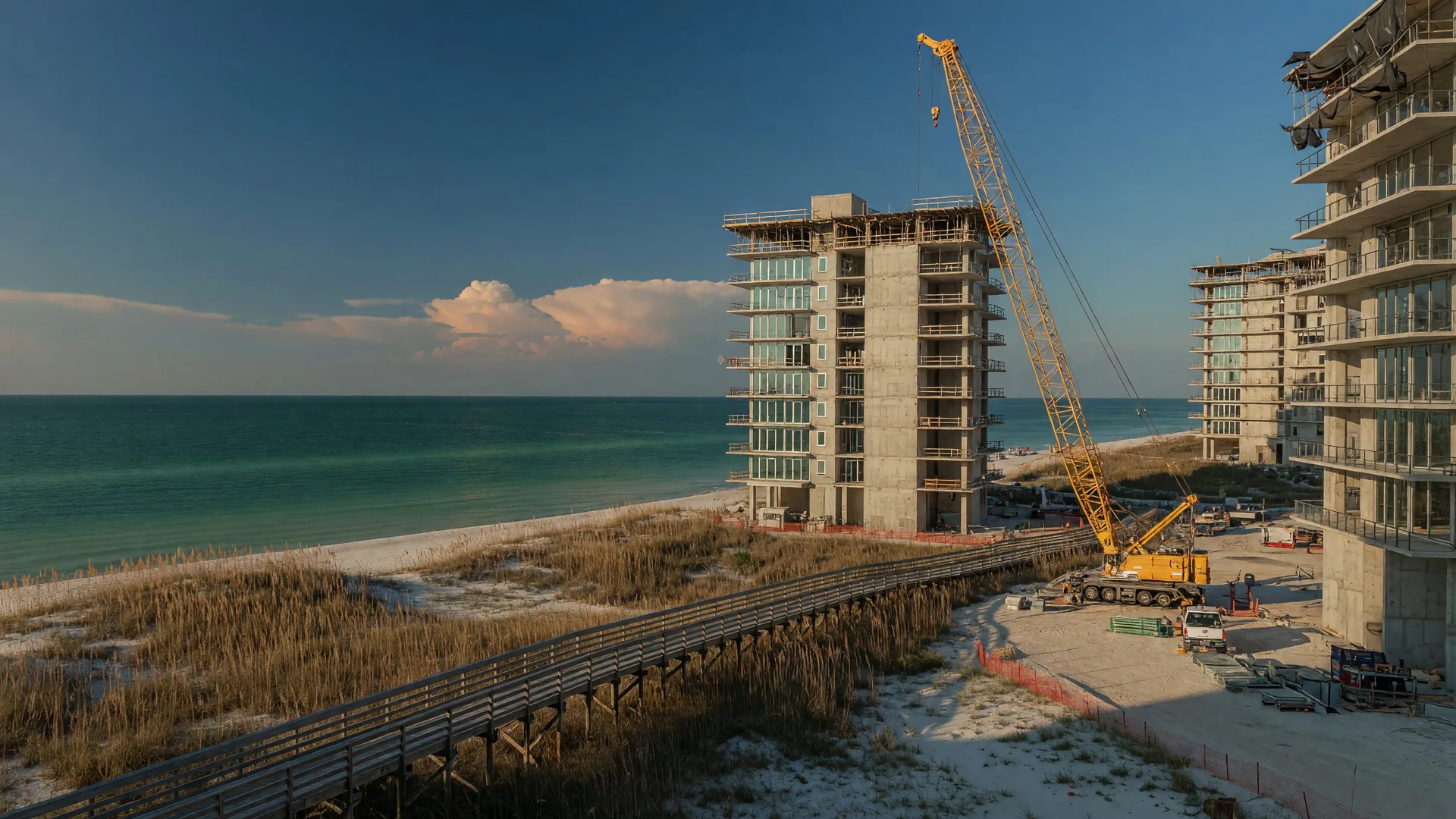
The Process of Condo Development in Baldwin County
Curious how a new condo tower actually gets built in Gulf Shores or Orange Beach, Alabama? The honest answer is that it takes years, a stack of approvals, and a lot of patience, because coastal construction here is regulated at three levels: the city, the state, and the building codes that keep up with hurricanes. If you are shopping for a condo or thinking about buying into a new development, understanding that process tells you a lot about the building you are considering.
In this post: how zoning and site plans work, what the Coastal Construction Control Line actually means, why modern hurricane codes matter, and how to use all of it when you are evaluating a new development or an established building.
What Does It Take to Build a Condo in Gulf Shores or Orange Beach?
If you are asking whether building a condo here is like building a house, here's the short answer: it isn't. A single-family home on a lot in Foley is one kind of project. A multi-story condominium on Gulf-front property is a different animal, with more approvals, more engineering, and more money tied up before the first slab gets poured.
Every coastal condo development in Baldwin County moves through the same basic sequence: confirm the zoning and land use, get a site plan approved, clear the state's coastal construction rules if the property crosses the Construction Control Line, then pull municipal building permits under the modern International Codes. Skip any of those steps and the project stops, which is exactly why you see cranes sitting over a site for so long before the building starts to rise.
For what owning one of those units costs after it's built, our condo investment guide walks through the rental math. Here, we are focused on how the building gets approved and built in the first place.
Step One: Zoning and Land Use Decide What Can Be Built
Every development starts with the zoning on the property. You cannot just buy a beachfront lot and stack condos on it, and a condo project usually needs the zoning to match the plan.
In Gulf Shores, the Planning and Zoning Department requires a site plan for any residential development of three or more units, and that approval has to come before a building permit can even be submitted. Larger projects often need a Conditional Use Permit, which gets heard by the Planning Commission and recommended to the City Council. That public process is where neighbors get to weigh in, and it's one reason you will sometimes hear about a coastal project that took longer than the developer expected.
Orange Beach runs its permits through an online portal, and projects over 35,000 square feet go through Planned Unit Development review before a building permit is issued. Both cities also apply architectural standards, so the look of the building, the setbacks, the parking, and the landscaping are part of the approval, not an afterthought.
Step Two: Site Plan Approval and the Planning Commission
The site plan is the developer's promise about how the property will be used: the building footprint, parking, drainage, access points, setbacks, and how the project handles stormwater and protects the dunes. On the coast, that last part matters more than people realize.
The Planning Commission reviews the plan against the city's zoning ordinance, and the public gets a chance to speak at the hearings. This is where road access, utilities, and density get scrutinized, and a condo tower on Perdido Beach Boulevard is a different conversation than a small complex on a quieter street.
If you are buying into a new development, ask whether the project went through full site plan and public review. It is a decent signal that the building was vetted, not just drawn on a napkin.
Step Three: The Coastal Construction Control Line and State Rules
Here is where beachfront gets different from inland. Alabama's Coastal Area Management Program, run through the Alabama Department of Environmental Management, regulates construction on properties that cross the Coastal Construction Control Line, the state line drawn to protect beaches, dunes, and the structures behind them.
If a project touches that line, the developer needs state authorization before construction, and multi-unit developments file a specific coastal application. The cities of Gulf Shores and Orange Beach are delegated to enforce these coastal rules locally, which is why you pull coastal permits through the city. The point is simple: buildings on the Gulf-front have to survive what the Gulf can throw at them.
This is also where the beach tax shows up before a single unit is sold. Elevation requirements, dune protection, wind engineering, and impact-rated glass all add cost, and that cost lands in the price of the finished units. Newer buildings carry it in the purchase price; older buildings carry it in insurance and assessments. Either way, somebody pays for the coast.
Step Four: Building Permits and Modern Hurricane Codes
Once zoning, site plans, and coastal approvals line up, the developer pulls building permits and construction can actually start. Both cities have adopted the modern International Building Code, and Orange Beach went a step further in 2026 with a Coastal Construction Supplement that pushes wind and water protection beyond the base code.
Construction documents have to be prepared by an architect or engineer registered in Alabama, and the work is inspected as it goes: foundations, framing, wind connections, waterproofing, and final systems. A Gulf-front tower built under today's codes is a different building than one built in the 1980s, and that difference shows up in insurance rates and how the building performs when a storm comes through.
If you are weighing new construction against an older building, our post on buying beachfront condos in Orange Beach compares the two honestly, and the condo buyer's guide has the full checklist.
Why the Process Matters When You're Buying
You might never read a zoning ordinance, and that is fine. But the process shapes the building you are buying into, so here are a few practical things to check:
- Ask about the coastal construction standard, not just the granite and the pool. Fortified roofs, impact-rated windows, and current wind connections are worth more than any finish upgrade.
- Check whether the project went through full site plan and coastal review. A building that cleared the public process got more scrutiny than one that slipped through.
- Read the HOA budget and reserve study before you fall for the sales center. New buildings still need reserves for the roof, elevators, and windows someday.
- Watch for phased developments. What is promised in phase two may not be built, and the amenities you toured may be years away.
- Get an actual insurance quote on the specific building before you make an offer. Trust me, pictures lie, and so do friendly estimates.
How Long Does a Condo Development Take?
If you are asking how long the whole thing takes, here's the honest answer: it varies, and it is almost always longer than people expect. Land acquisition, financing, approvals, and construction each have their own timeline, and a Gulf-front tower is a multi-year project from dirt work to move-in.
Weather matters too. Hurricane season can pause construction for weeks. The takeaway is not to anchor on a completion date from a sales pitch. Ask what phase the project is in, what approvals are still pending, and what happens to your deposit if the timeline moves.
What This Means for Buyers and Investors
If you are evaluating a new development, the process is actually your friend. The more approvals a project went through, the more eyes were on it: planners, engineers, inspectors, and the public.
And if you are thinking about the investment side, remember that new construction usually means lower insurance and less near-term maintenance, which changes the cash-flow picture. Run the numbers on the beach condo cash-flow calculator and see what the monthly reality looks like before you commit.
"People aren't buying these condos for the drywall, they're buying a lifestyle: the sunrise over the water, the boat in the slip, the walk to the beach. The process just has to be honest enough to let them enjoy it."
People Also Ask
How long does it take to build a condo in Gulf Shores, Alabama?
Most Gulf-front condo developments are multi-year projects from land acquisition through move-in. Timelines vary with the size of the project, financing, and hurricane season, so ask what phase a development is in and what approvals are still pending.
Do you need a permit to build a condo on the beach in Alabama?
Yes, and usually several. Developers need site plan approval and building permits from the city, and if the property crosses the Coastal Construction Control Line, they also need state coastal authorization. Gulf Shores and Orange Beach enforce these coastal rules locally.
What is the Coastal Construction Control Line in Alabama?
It is a state line drawn along the coast to protect beaches, dunes, and the structures behind them. Construction on properties that cross the line is regulated by ADEM under the Coastal Area Management Program, and multi-unit developments must file a specific coastal application before building.
Are new condos in Gulf Shores built to stronger hurricane codes?
Generally, yes. Both Gulf Shores and Orange Beach have adopted the modern International Building Code, and Orange Beach added a Coastal Construction Supplement in 2026 that strengthens wind and water protection. Newer buildings typically qualify for better insurance rates because of it.
Can you build a condo anywhere in Orange Beach?
No. Zoning decides what can be built where, and larger projects over 35,000 square feet go through Planned Unit Development review before a building permit is issued. Architectural standards and coastal rules also apply, so the location has to support the project.
Why does it cost so much to build on the coast?
Elevation requirements, dune protection, wind engineering, impact-rated glass, and the cost of construction on a storm-prone shoreline all add up. Those costs land in the finished price of new units, which is part of why newer Gulf-front condos sit at the top of the local market.
Bottom Line
The process of building condos in Gulf Shores and Orange Beach is slow on purpose, and that is mostly a good thing for buyers. Zoning, site plans, coastal rules, and modern building codes exist so that the buildings on our shoreline are built to last, and the ones that clear that gauntlet tend to be the ones worth buying into.
You don't have to be a millionaire to live at the beach, but you do want to buy into a building that was built right. If you are weighing a new development or an established tower, I am happy to walk you through what the process says about it. The goal is freedom, time freedom and location freedom, and buying the right building is how you get there.
See y'all at the beach. — Andy
Ready to look at what's being built?
Whether you are evaluating a new development or an established building, I can pull the HOA budgets, insurance quotes, and approval history for the projects you are considering. No scripts, no pressure, just the real numbers.
Learn More